

OVERVIEW
The LC-063 / Kimat External Watchdog Timer (EXT
WDT) v2.0 module provides a reliable external signal to
allow most microcontroller (MCU) boards including
Arduino boards to reset whenever a software or
hardware malfunction halts the microcontroller. This
module simplifies external WDT implementation by
providing the necessary hardware in a small package
with standard 2.54mm headers.
While some microcontrollers already feature an internal
watchdog timer, this module is 100% independent of
the operation of the target microcontroller being
monitored ensuring that the safety circuit operates
regardless of internal microcontroller issues. Having an
external WDT solution also eliminates all the issues
related to the implementation of an internal watchdog
timer.
HIGH and LOW. This signal comes from any available
GPIO from the target microcontroller. The signal is then
used by the module to determine if the target is
working normally. Whenever the strobe signal does not
change state within the selected WDT timeout period,
the target’s reset pin is pulled low causing a hard reset
on the target and promoting immediate recovery.
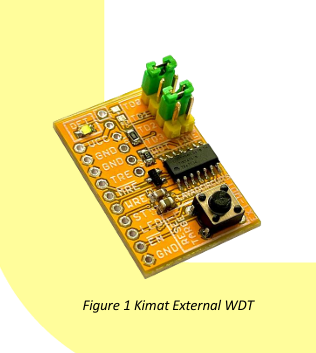
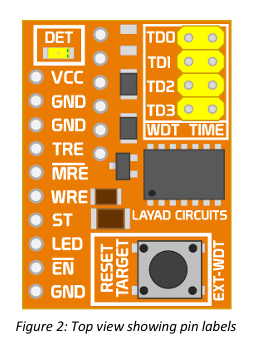
The module has a built-in LED (DET) that blinks every
time the strobe signal, coming from the target, changes
state between HIGH and LOW. The module features a
selectable WDT timeout via the onboard micro jumpers.
It also has a physical button that may be used to
manually trigger a reset on the target. A digital control
pin labeled EN is also provided to allow the target
microcontroller to temporarily disable the WDT function
of the module should there be a need
The module follows typical WDT implementation plus
other important features. The module accepts a simple
digital strobe signal that is made to toggle between
FEATURES
- No external components required
- Minimum of one output from the target
- 11 user – selectable watchdog timeout periods
- Enable/Disable via EN pin
- 3.3V/5V operating voltage
- Current consumption of less than 100mA
- On board target reset button
- Strobe signal detection LED indicator
- Arduino compatible, Standard 2.54mm headers
PIN FUNCTIONS
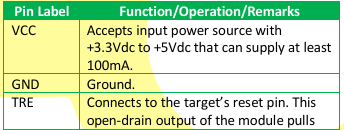
The module has a 10 pin 2.54mm pitched main header
with the following functions.


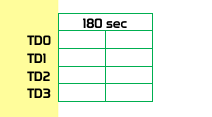
In cases where no jumpers are installed, the WDT will
choose a timeout of 180 seconds or 3 minutes.
STROBE MONITORING DELAY
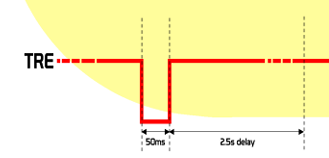
After the target microcontroller is reset by the module,
it will automatically prompt the External WDT to enter a
2.5 seconds delay to accommodate bootup time of the
target. The watchdog monitoring features are only
enabled after this delay.

In the example code, the strobe signals are toggled
every 1000 milliseconds hard delay. In actual
implementations, this may not be the case. The target
needs to simply toggle the strobe signal at an interval of
at least 1 microsecond gap to ensure its detection. A
typical application would insert the strobe state
changes at the top of the application code and another
somewhere at the middle of the code.
WDT TIMEOUT SELECTION
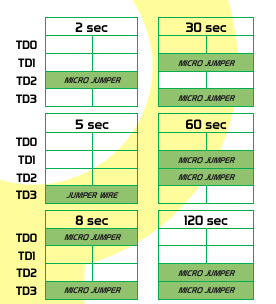
The user can pre-select the watchdog timeout period by
installing either one, two or none of the micro jumpers
on the WDT TIME header. This timeout is the time
within which the module must receive a falling or rising
edge on the strobe pin to keep the TRE pin high. If the
strobe signal does not change within this period, the
TRE pin is pulled LOW, and hence generating a reset on
the target. Refer to the diagrams below for the micro
jumper position and its corresponding timeout.
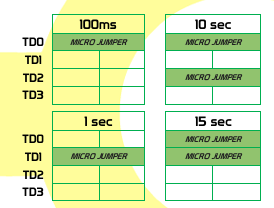
Figure 3: Shows the 2.5 seconds delay implemented after the
TRE pin is pulled low for 50ms by the module. During the 2.5
seconds delay, no watchdog functions are enabled to allow
the target to fully boot up.
Note: An Arduino UNO has an average bootup time of
1.8 seconds after reset.
For boards that require more than 2.5 seconds to boot
up, select the timeout periods that are longer than 2.5
seconds. This ensures that whenever a reset is
generated by the EXT WDT by pulling the TRE low, the
target has sufficient time to boot up and start
generating the strobe signals.
EXAMPLE APPLICATION
The LC-063 / Kimat External Watchdog Timer (EXT WDT)
ensures continuous run time of the target
microcontroller. If target microcontroller fails to
properly execute code due to any reason, the strobe
signal may not change and hence, the LC-063 module
will trigger a reset on the target by pulling the reset pin
of the target Arduino/Saleng Uno board via the TRE pin.
WIRING
The VCC of the Kimat External WDT is sourced from the
Saleng Uno/Arduino Uno’s 5V pin. The Saleng Uno is
powered using the DC jack with a supply range of 6 to
9v or powered via the USB port. The pin connections of
the Saleng UNO with Kimat External WDT are as follow:
EXAMPLE CODE
// This sketch uses pin 7 to generate strobe pulses every 1 secs
// Arduino uno has an average 1.8s bootup time and the WDT has 2.5s delay to compensate for it
// This uses the built-in LED as an indicator for the pulses generated
void setup(){
Serial.begin (9600);
pinMode (7, OUTPUT);
pinMode (LED_BUILTIN, OUTPUT);
Serial.println("LAYAD CIRCUIT SAMPLE CODE");
}
void loop() {
digitalWrite (7, HIGH);
digitalWrite (LED_BUILTIN, HIGH);
delay (1000);
//the rest of the code go here
digitalWrite (7, LOW);
digitalWrite (LED_BUILTIN, LOW);
delay (1000);
//the rest of the code go here
}

//choose the baud rate, default set as 9600
//set pin 7 to send pulses to ST
//pulse indicator
//shows up on serial monitor every reset
//toggle/change the strobe signal
//turn the LED on
//wait for a second to ensure 1uS interval
//toggle/change the strobe signal
//turn the LED off
// wait for a second to ensure 1uS interval